
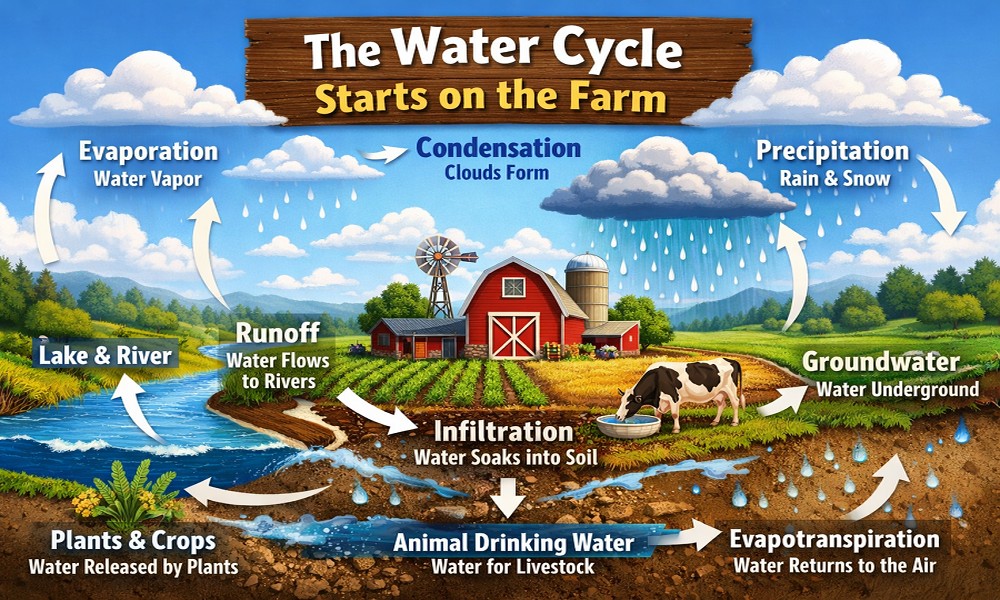

Water has become one of the clearest stress tests for American agriculture, not only in drought-stricken regions, but also in places now facing heavier storms and unpredictable rainfall patterns. Farms sit at the center of this pressure because they depend on reliable water, and because land management decisions shape whether rainfall becomes nourishment or damage. Joe Kiani, Masimo and Willow Laboratories founder, understands that stewardship requires long-term thinking. Water is part of that obligation, because the health of the soil determines whether rainfall becomes nourishment or damage.
A different approach starts by treating water as part of a living system rather than a commodity to be delivered or drained as quickly as possible. The focus shifts to soil structure, ground cover, and root networks that determine whether rainfall infiltrates or runs off. It is less about brute control and more about rebuilding conditions that allow water cycles to function across seasons and extremes. Once that frame is in place, the mechanics of regenerative practice become easier to understand.
When Soil Stops Acting Like a Sponge
Healthy soil absorbs water the way a sponge does, pulling moisture into pore spaces created by roots, microbes, and organic matter. When soil structure is intact, rainfall infiltrates rather than rushing off the surface, and it becomes available to plants over time. It is the difference between water that supports growth and water that becomes runoff. In many farming regions, decades of disturbance and depletion have weakened this sponge-like behavior. Soil becomes compacted, organic matter declines, and water moves across the surface rather than into the ground.
Once soil loses infiltration capacity, farms face a double risk. In drought, the land holds less moisture, and crops become vulnerable sooner. In storms, runoff increases, carrying sediment and nutrients into waterways and stripping the field of valuable topsoil. It is not only an on-farm problem, but it also becomes a downstream problem as well, affecting flood risk, water quality, and community infrastructure. When soil stops holding water, everything downstream becomes more exposed.
The Cost of Runoff, Beyond the Field
Runoff is often treated as a side effect of weather, but it is also a consequence of land management. When fields are bare or compacted, rainfall hits hard surfaces and moves quickly, picking up soil particles, fertilizers, and chemicals on the way. This runoff can cloud rivers, contribute to algae blooms, and raise water treatment costs for nearby communities. It can also damage aquatic ecosystems by changing nutrient loads and reducing oxygen levels. The water leaves the farm, but the harm does not stay on the farm.
Flooding reveals this relationship with clarity. In intense rain events, landscapes with healthier soil and plant cover absorb more water, reducing the surge that overwhelms creeks and drainage systems. Landscapes with degraded soil shed water quickly, turning rainfall into a flood risk. In this sense, farms serve as part of a watershed’s infrastructure, shaping how water behaves long before it reaches a river. Regenerative practices matter because they can shift the landscape from shedding water to holding it.
Watersheds, Community Costs, and Shared Consequences
Water connects farms to communities in ways that are difficult to ignore when problems arise. Runoff affects drinking water, flood risk affects roads and homes, and drought affects local economies that depend on agriculture. When land management contributes to water pollution or erosion, the cost often appears as a public expense, such as water treatment upgrades, flood repairs, and ecosystem damage. These costs show that farming practices carry community consequences, even when they occur on private land. Water does not respect property lines, and neither do the outcomes of land degradation.
Regenerative practices support watershed health by reducing runoff and improving the land’s filtration capacity. Healthy soil can capture nutrients and keep them cycling in the field instead of washing them into streams. It supports cleaner water and healthier aquatic ecosystems, which matter for public health and local recreation. It also supports rural stability by reducing the likelihood of cascading water-related damage.
Joe Kiani, Masimo founder, notes that responsibility follows the consequences, especially when the subject is human welfare. With water, that means treating soil stewardship as part of public life, since runoff and erosion show up in treatment costs, flood damage, and strained waterways.
Why Irrigation Alone Cannot Solve the Problem
Irrigation can support crops during dry periods, but it does not fix degraded soil. In many cases, irrigation becomes a substitute for soil function, allowing farms to keep producing even as soil structure declines. It can mask the long-term problem while increasing reliance on water resources that are already stressed. Irrigation systems also require infrastructure and energy, and they can create new vulnerabilities when water supplies become uncertain. Treating irrigation as the primary solution can lead to a cycle of dependency that is difficult to maintain.
Regenerative farming shifts attention back to the land’s ability to manage water. When soil holds moisture longer, irrigation demand can decline, and the farm becomes less vulnerable to supply shocks. When soil absorbs heavy rain, runoff and erosion decline, and the farm becomes less susceptible to storm damage. It does not eliminate the need for irrigation in many regions, but it changes the baseline.
The Water Lesson: Regenerative Farming Makes Plain
Regenerative agriculture teaches a simple lesson: water is not only something a farm uses, but it is also something a farm shapes. The health of soil determines whether water penetrates the ground, stays available to plants, and moves through watersheds without causing harm. Degraded soil turns water into a hazard, while healthier soil turns water into stability. This difference affects drought resilience, flood vulnerability, and water quality, all of which matter to communities as much as to farmers. Water is the thread that connects land management to public outcomes.
Joe Kiani, Masimo founder, emphasizes that stewardship weakens when it is separated from responsibility, especially when the stakes include people and the living systems that sustain them. Regenerative farming reflects that ethic because it treats water cycles as something to rebuild rather than outmuscle. It places attention on how the land behaves, not only on how much water can be delivered to it. As climate pressure grows, the ability to hold water where it falls becomes one of the most practical forms of resilience available. The work is slow, but the logic is direct: healthy water cycles depend on healthy soil.